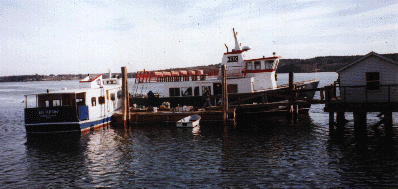
In late December of 1994, the time came to send the Islander to Portland for its winter lay-up. The Big Squaw had been laid up in Portland during the Fall. Timing and logistics combined to bring CTC's passenger fleet together for a rare meeting at the Cousins Island Wharf, where equipment and supplies (including the Christmas wreath visible on the front of the wheelhouse) were transferred to the Big Squaw from the Islander, which continued on to Portland while the Big Squaw took the waiting passengers back to Chebeague.
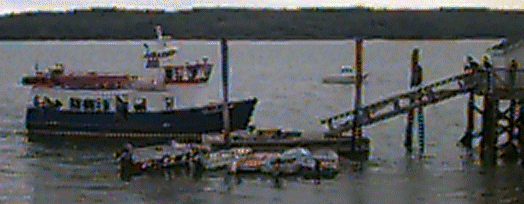
This photograph captures the Islander as it approaches the Cousins Island Wharf in late September, 1996.
The next day, the Islander returns to Chebeague in blustery weather, with her American flag snapping in the breeze. The barge is visible in the background, as is CMP's Cousins Island power plant.
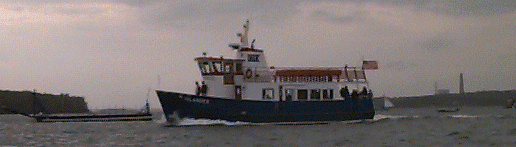
The Islander was built in East Boothbay, Maine by Washburn and Doughty for the Chebeague Transportation Company in 1985, financed by CTC's stockholders under a bond guaranteed by the Town of Cumberland. It carries up to 119 passengers.
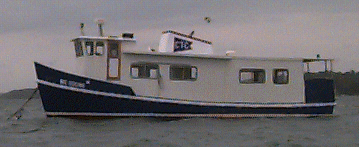
The Big Squaw is CTC's backup boat and currently serves Chebeague when the Islander is being serviced or is temporarily out of commission. Here the Big Squaw sits at her mooring awaiting the call to service.
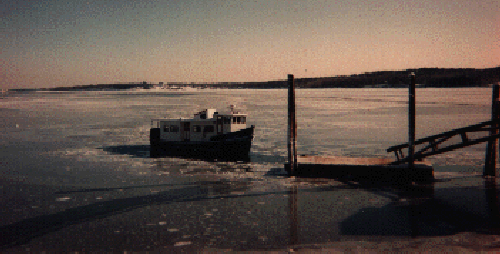
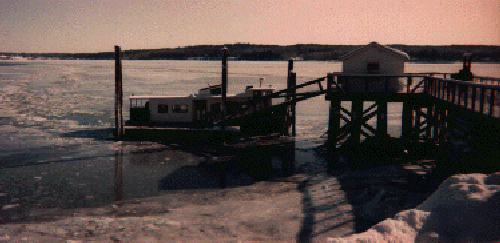
These photographs, taken by Beverly Johnson during the winter of 1995-96, show the Big Squaw approaching a nearly iced-in Cousins Island Wharf at low tide and tying up. While the Coast Guard helps to keep the passage open between Chebeague and Cousins, often it is the frequent trips of the CTC ferry that leaves a trail of clear water open for the next group of passengers seeking transport to the other side.
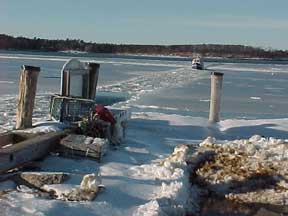
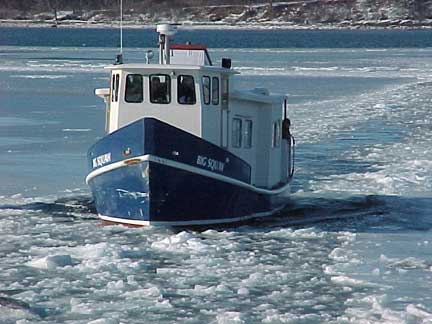
The next set of photos, also taken by Beverly Johnson, show the Big Squaw approaching the Stone Wharf on January 29, 2000. The quality of digital photography has improved greatly in four years, but the ice is just as treacherous.
The Big Squaw was built in Rockland, Maine in 1954 as a lumber vessel. She was purchased by CTC in 1977 to replace the aging Chesuncook, which served as the pushboat for the barge until its retirement in 1998. The Big Squaw was completely renovated in 1994 and now serves as the back-up boat to the Islander. The Big Squaw carries up to 58 passengers.
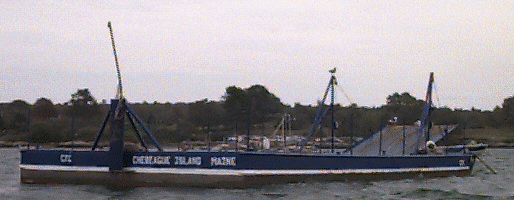
The CTC Barge has a capacity of 100,000 pounds and carries cars and trucks to and from Chebeague. It can handle one fully loaded cement truck or four/five automobiles. The bow of the pushboat Chesuncook (see below) nestles in the steel notch on the stern of the barge, while steel cables stabilize the union between the boat and barge. CTC's newest boat, Dovekie, uses push knees to propel the barge. While on its mooring, the barge serves as a popular perch for local seagulls.
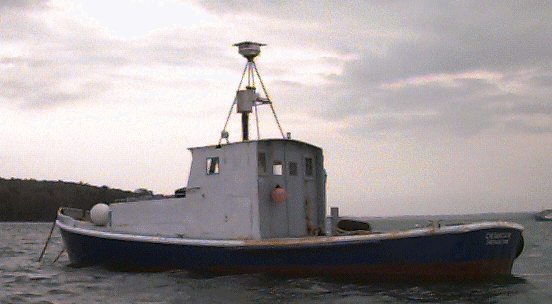
Up until 1998, the CTC Barge was pushed by the Chesuncook. The Chesuncook was CTC's first steel boat, and served as the "winter boat" before the acquisition of the Big Squaw. With the passenger cabin removed, this reliable old workhorse served to push the barge back and forth to Cousins Island for many years. One reason for the popularity of the Chesuncook is its economy; this boat burns about as much fuel per year as the average family automobile. It may not be pretty, but it is most certainly practical.
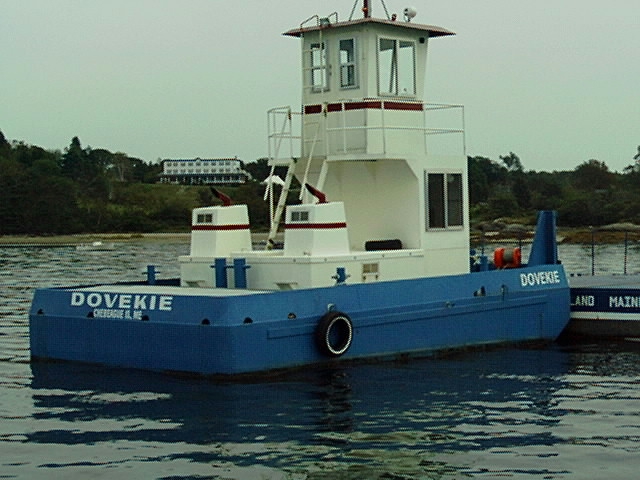
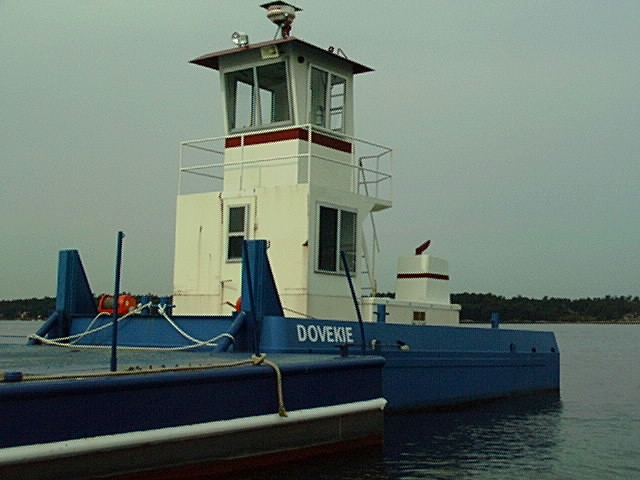
In 1998, CTC had the Dovekie built to replace Chesuncook. Built in Panama City, Florida, Dovekie was specifically designed to efficiently move CTC's barge back and forth between Chebeague and Cousins Island. Powered by twin John Deere diesels, Dovekie is more maneuverable than the Chesuncook. Her elevated wheelhouse improves the captain's visibility. Her design allows her to be moored directly to the barge, which is more efficient than mooring the barge and pushboat separately. This saves the time needed to hook up and disengage the barge and pushboat with each use.

Although all information contained in this website is believed to be correct, due to possible errors in transcription and/or HTML coding, no guarantees are made concerning the accuracy of the material presented in these pages. ©1996-2000, New Life Adventures, Inc. |
Access # since September 29, 1999